PARIS — The war in Ukraine is driving a shift toward fast-changing, mass warfare that Western militaries are unprepared for, while Russia is adapting rapidly, according to Adm. Pierre Vandier, NATO’s Supreme Allied Commander Transformation.
The gap between what Europe should be doing for defense and its actual capabilities undermines deterrence, risking Russian aggression if Moscow concludes Europe or NATO are too weak to resist attack, Vandier said at the Paris Defense & Strategy Forum on March 25.
Ensuring Europe’s safety in the next decade requires “a dramatic increase of credibility of our deterrence,” he said.
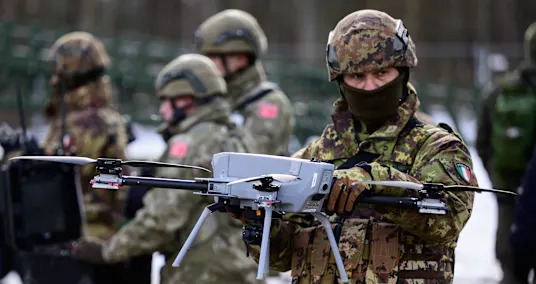
Russia’s invasion of Ukraine sparked a technology race, with Ukraine innovating to make up for its smaller force and Russia adapting in response. The result is a war unlike any NATO has faced, with thousands of drones used each day on a battlefield saturated by electronic warfare, where constant surveillance makes movement deadly and unmanned systems destroy tanks and warships.
“A shock is a period where you need to invent a new world, a new way of doing things,” Vandier said. “It’s what you see in Ukraine. Short of everything but the enemy, they have to invent a new war. And this is coming. And our enemies are doing the same, they are inventing the next war.”
While the evolution of warfare in Ukraine and now the Middle East signals an “era of shocks,” Europe remains in crisis-management mode, according to Vandier. He said countries need to start delivering, because “we are weak, the stockpile is not very big, the enemy knows that.”
The challenge is not to simply continue along the same lines, but to evaluate what is needed to maintain security in a “totally different world,” Vandier said. The return of mass is one of the key challenges for allies not organized for that kind of warfare, with many Western systems that can’t be mass produced.
“How do we deal with mass?” Vandier asked. “And as far as I can see, it’s the same problem on the other side of the Atlantic. If we do more of the same, we will not answer the question.”
Vandier said Russia and Iran produce hundreds of Shahed drones for every single AIM-120 or AIM-9 interceptor, and doubling or tripling output won’t close that gap. Protecting Europe with Patriot air-defense batteries would require ten times as many, but with a seven-year lead time, “you will not be protected by Patriots in the next five years.”
“You have far more targets than weapons to kill it,” Vandier said. “You need to invent something different. It’s what is going on in Ukraine.”

Vandier warned that simply spending more won’t be enough, noting how Gulf states have struggled to defend critical infrastructure against waves of relatively cheap Iranian drones and missiles despite vast resources. Western failure to prepare risks similar vulnerabilities, he said.
“It’s not a question of money, it’s a question of speed, it’s a question of making the right choices,” Vandier said. “More of the same will not save us.”
Speed of adaptation remains a core issue, with common-funded NATO projects taking years just to define requirements as countries seek to include their specifications, Vandier said. Meanwhile, Shahed drones have received five updates since a drone incursion in Poland in September, according to the NATO commander.
The Western defense industry needs “newcomers that will do the things at the speed of relevance,” Vandier said, even as NATO still relies on traditional manufacturers of major platforms such as fighter jets, aircraft carriers, submarines and battle tanks. But those systems must adapt quickly to new threats.
“Today, if you do not adapt your jammers, your tank will be destroyed in 10 minutes,” Vandier said. “If you don’t protect your frigate against drones, it will be sunk in 10 minutes.”
Vandier cited countries saying they’ll buy frigates first and address drones in 10 years, warning they may lose their frigates on the first night of a war. He said Russia has learned the lesson from Ukraine and knows the cost of not being protected against unmanned surface vehicles, and is reverse engineering Ukraine’s sea-going drones.
“I’m not saying you get rid of frigates, because to go in the middle of the Atlantic, to chase a Yasen-class submarine, we’ll not do that with drones today,” Vandier said. “But in the Baltic, your harbor may be overwhelmed by drones, as Ukraine did with the Russians.”
NATO needs to invent the next war rather than prepare for the last one, “because the last one, the Russians think they can win,” Vandier said. “But the next one, they don’t know.”
Vandier dismissed ideas that Ukraine is fighting a specific war because the country lacks modern air power, and that NATO would fight differently. “The enemy has changed,” he said. “Russia is no longer what it looked like four years ago. So we need to be prepared for a new enemy.”
Europe needs to deliver on deterrence to force the enemy to recalculate, and given sanctions on Russia and Europe’s pool of hundreds of thousands of engineers, “we need to demonstrate we can win it,” Vandier said.
The NATO commander said he’s confident Europe can deliver, but “there is an urgency. We need to do it now, tomorrow, and not in 10 years.”
NATO will organize a large-scale counter-drone exercise in Romania in April, and while all countries are invited, for now only 20 of the 32 member states are signed up, with 24 companies participating, according to Vandier.
The admiral says he’s bought €10 million ($11.5 million) worth of targets, and for more than a week, “six hours a day, we shoot and shoot and shoot. We’ll see who are the liars, who are the champions amongst the twenty.”
The exercise will give decision makers insight into who is delivering results rather than glossy presentations, Vandier said.
The defense industry also needs different key performance indicators, or KPIs, that reflect the new way of war, such as price per shot, scalability, interoperability and adaptability. He said vendor-lock-in systems where “you pay a million euros for a new line of code, this is finished. That will never work again.”
Vandier described visiting a concealed drone factory in a Kyiv neighborhood, where 1,000 workers led by a 30-year-old former childcare worker produce 3,000 drones a day while operating off-grid to evade detection.
“We need to avoid that,” Vandier said. “We need to be smarter. We need to invent the war that Russia will lose.”
“We need to make Russia wake up each morning, thinking to themselves: ‘Not today.’”
LATEST POSTS
- 1
 Instructions to Pick the Best Album Rates for Your Investment funds
 - 2The Universe of Impeccable Pearls: A Manual for Valuable Gems
- 3Tech Devices 2023: The Most blazing Arrivals of the Year
- 4Bruno Mars tour 2026: How to get tickets for 'The Romantic Tour,' presale times, prices and more
- 510 Hints and Deceives to Expand Cell Phone Information Use: Capitalize on Your Information




- Favored Organic product for Seniors' Prosperity: Make Your Determination
- Human evolution’s biggest mystery has started to unravel. How 2025 tipped the scales
- Novo Nordisk slashes prices of popular weight loss and diabetes drugs
- Discovery of ancient pleasure boat reveals Egypt's maritime history
- She just became the first wheelchair user to travel to space
- 'Wow!' The eye surgery marathon that restored sight for some South Africans
- Two Israeli infants among wounded by shrapnel in overnight Iranian missile barrage
- Fascinating Fishing Objections From Around The World
- Which restaurants and fast food chains will be open on Christmas Eve and Christmas Day?