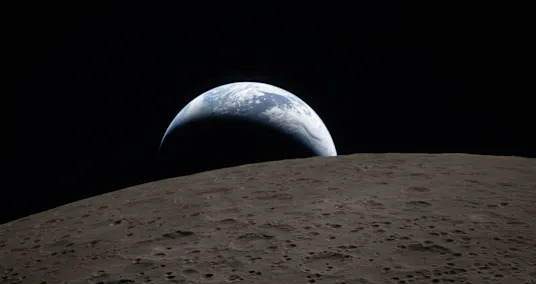
HOUSTON (AP) — The Artemis II astronauts are now forever intertwined with Apollo 8.
A day after the historic lunar flyaround, NASA on Tuesday released striking new photos taken by the U.S.-Canadian crew.
The four astronauts channeled Apollo 8’s famous Earthrise shot from 1968 with their own: Earthset, showing our planet setting behind the gray, pockmarked moon. Another photo captures the total solar eclipse that occurred when the moon blocked the sun from the crew’s perspective.
The three Americans and one Canadian are now headed home, with a splashdown in the Pacific set for Friday. In the meantime, scientists at Houston's Mission Control are poring over the stream of moon photos beaming down.
Apollo 8's three astronauts became the world's first lunar visitors, orbiting the moon on Christmas Eve 1968. Their Earthrise shot became a symbol of the modern-day environmental movement.
Artemis II marks NASA's first return to the moon with astronauts — a critical step toward a lunar landing by another crew in two years.
___
The Associated Press Health and Science Department receives support from the Howard Hughes Medical Institute’s Department of Science Education and the Robert Wood Johnson Foundation. The AP is solely responsible for all content.
LATEST POSTS
- 1
 Israel kidnaps PIJ terrorist in covert op. in Hamas-controlled Gaza in pursuit of Ran Gvili
 - 2Famous Kitchen Finishing Styles For 2024
- 3Why don’t humans have hair all over their bodies? A biologist explains our lack of fur
- 4McDonald's is bringing two 'KPop Demon Hunters' meals to McDonald's. Here's what they include and when they launch.
- 55 Great Crossover Vehicles For Eco-friendliness In 2024




- Hand Skin Is Additionally Significant - What You Ought to Realize About Hand Cream
- Father and son spending Christmas together after health scares
- Iran war triggering Easter staycation boom
- 13 must-see moon events in 2026: Eclipses, supermoons, conjunctions and more
- Europe pledges over €15bn for clean energy for Africa
- 4 Coolers for Present day Kitchens
- How did life begin on Earth? New experiments support 'RNA world' hypothesis
- Safeguarding Your Senior Protection Against Extortion and Tricks.
- New movies to watch this weekend: See 'Predator: Badlands' in theaters, rent 'Black Phone 2,' stream Guillermo del Toro's 'Frankenstein' on Netflix