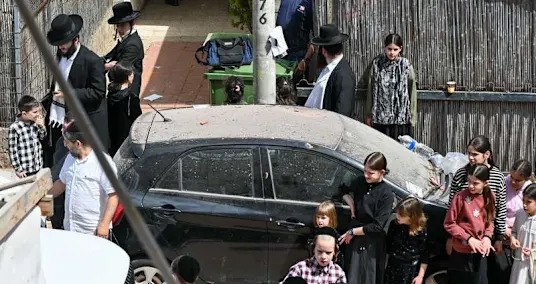
Iran and its Lebanese Hezbollah militia proxy on Thursday fired rockets again at Israel, where people are currently celebrating Passover.
In the morning, warning sirens sounded repeatedly in northern Israel. Two men were slightly injured by a Hezbollah rocket, the Magen David Adom emergency service said.
An Iranian rocket also aimed at the north was fitted with cluster munitions, Israeli media reported. The use of cluster munitions is widely banned internationally because they can scatter explosive devices uncontrollably over large areas and are particularly dangerous for civilians.
There was also repeated fire at Israel overnight. A rocket alert was triggered in the coastal metropolis of Tel Aviv, among other places. Magen David Adom reported several people with minor injuries from broken glass in a suburb of Tel Aviv, including two babies.
The week-long Passover festival began on Wednesday evening for Jews around the world. It commemorates the exodus of the Israelites from Egypt and their liberation from slavery.
LATEST POSTS
- 1
 How to watch Dick Clark’s New Year’s Rockin’ Eve with Ryan Seacrest: Start time, TV channel, performers and more
 - 25 Instructive Toy Brands for Youngsters
- 312 times rockets and spacecraft crashed and burned in 2025
- 4EU Commission slams Israel's death penalty law for Palestinians
- 5‘Grit’ and relentless perseverance can take a toll on brain health − particularly for people facing social stresses like racism



- Dave Coulier shares new cancer diagnosis 1 year after revealing previous diagnosis
- These 3 Nail-Free Finds Completely Transformed My Drab Bathroom
- The Best Computer games Ever
- Remote Headphones: Upgrade Your Sound Insight
- Astonishing interstellar comet captured in new images by NASA Mars missions
- 5 Different ways Macintosh is Prepared to Overwhelm Gaming, Even Against Windows
- Must-Have Cooking Machine in Your Kitchen
- Don't miss Jupiter shining close to the waning gibbous moon on Dec. 7
- South Africa pushes for $200B investment