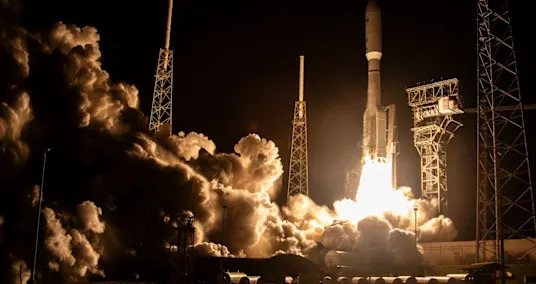
CAPE CANAVERAL, Fla. (AP) — Blue Origin launched its huge New Glenn rocket Thursday with a pair of NASA spacecraft destined for Mars.
It was only the second flight of the rocket that Jeff Bezos’ company and NASA are counting on to get people and supplies to the moon — and it was a complete success.
The 321-foot (98-meter) New Glenn blasted into the afternoon sky from Cape Canaveral Space Force Station, sending NASA’s twin Mars orbiters on a drawn-out journey to the red planet. Liftoff was stalled four days by lousy local weather as well as solar storms strong enough to paint the skies with auroras as far south as Florida.
In a remarkable first, Blue Origin recovered the booster following its separation from the upper stage and the Mars orbiters, an essential step to recycle and slash costs similar to SpaceX. Company employees cheered wildly as the booster landed upright on a barge 375 miles (600 kilometers) offshore. An ecstatic Bezos watched the action from Launch Control.
“Next stop, moon!” employees chanted following the booster's bull's-eye landing. Twenty minutes later, the rocket's upper stage deployed the two Mars orbiters in space, the mission's main objective. Congratulations poured in from NASA officials as well as SpaceX's Elon Musk, whose booster landings are now routine.
New Glenn’s inaugural test flight in January delivered a prototype satellite to orbit, but failed to land the booster on its floating platform in the Atlantic.
The identical Mars orbiters, named Escapade, will spend a year hanging out near Earth, stationing themselves 1 million miles (1.5 million kilometers) away. Once Earth and Mars are properly aligned next fall, the duo will get a gravity assist from Earth to head to the red planet, arriving in 2027.
Once around Mars, the spacecraft will map the planet’s upper atmosphere and scattered magnetic fields, studying how these realms interact with the solar wind. The observations should shed light on the processes behind the escaping Martian atmosphere, helping to explain how the planet went from wet and warm to dry and dusty. Scientists will also learn how best to protect astronauts against Mars' harsh radiation environment.
“We really, really want to understand the interaction of the solar wind with Mars better than we do now,” Escapade’s lead scientist, Rob Lillis of the University of California, Berkeley, said ahead of the launch. “Escapade is going to bring an unprecedented stereo viewpoint because we’re going to have two spacecraft at the same time.”
It’s a relatively low-budget mission, coming in under $80 million, that's managed and operated by UC Berkeley. NASA saved money by signing up for one of New Glenn’s early flights. The Mars orbiters should have blasted off last fall, but NASA passed up that ideal launch window — Earth and Mars line up for a quick transit just every two years — because of feared delays with Blue Origin's brand-new rocket.
Named after John Glenn, the first American to orbit the world, New Glenn is five times bigger than the New Shepard rockets sending wealthy clients to the edge of space from West Texas. Blue Origin plans to launch a prototype Blue Moon lunar lander on a demo mission in the coming months aboard New Glenn.
Created in 2000 by Bezos, Amazon's founder, Blue Origin already holds a NASA contract for the third moon landing by astronauts under the Artemis program. Musk’s SpaceX beat out Blue Origin for the first and second crew landings, using Starships, nearly 100 feet (30 meters) taller than Bezos' New Glenn.
But last month NASA Acting Administrator Sean Duffy reopened the contract for the first crewed moon landing, citing concern over the pace of Starship’s progress in flight tests from Texas. Blue Origin as well as SpaceX have presented accelerated landing plans.
NASA is on track to send astronauts around the moon early next year using its own Space Launch System, or SLS, rocket. The next Artemis crew would attempt to land; the space agency is pressing to get astronauts back on the lunar surface by decade’s end in order to beat China.
Twelve astronauts walked on the moon more than a half-century ago during NASA's Apollo program.
___
The Associated Press Health and Science Department receives support from the Howard Hughes Medical Institute’s Department of Science Education and the Robert Wood Johnson Foundation. The AP is solely responsible for all content.
LATEST POSTS
- 1
 Astronomer captures 2 meteors slamming into the moon (video)
 - 2Italy Brings In New Measures In 2026 To Tackle Overtourism
- 3Without evidence, CDC changes messaging on vaccines and autism
- 4Over 250,000 cases of shredded cheese recalled over possible metal fragments
- 5Emergency services search for five people last seen in missing Jeep




- Man triggers smoke bomb during failed crypto robbery
- 5 Indoor Plants That Further develop Air Quality
- Gunmen open fire near Israeli consulate in Istanbul in possible ISIS-linked attack
- Artemis moon mission breaks record for distance from Earth
- Recent studies prove the ancient practice of nasal irrigation is effective at fighting the common cold
- Toyota’s Next Big Sports Car Might Apparently Be a Turbocharged All-Paw Beast
- In blow to Lula, Brazil Congress revives controversial environmental bill
- Dutch police probe a small blast outside a pro-Israel Christian center
- Watch Atlas V rocket launch its heaviest-ever payload early on April 4