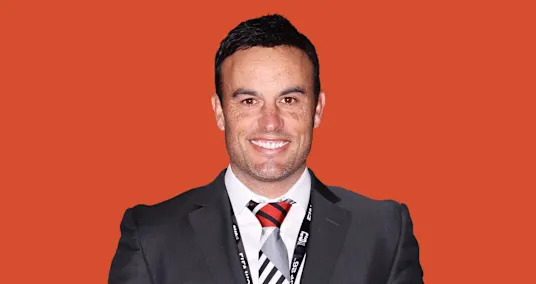
Soccer icon Landon Donovan’s list of accolades already stretches the length of a field — from becoming a breakout star at the 2002 World Cup at just 20 to delivering one of the most memorable moments in U.S. soccer history in 2010. Now, he’s added published author to that list, though he’s the first to admit his memoir, Landon, is a passion project, not a paycheck.
“I didn’t need to do it,” the retired player tells me for Yahoo’s Off the Cuff series. “I didn’t need the attention or the money. It’s a lot of work. Ultimately, I’m a person who cares and wants to help people.”
That drove the 44-year-old father of three to go deep, sharing how he survived his hardest days. There are plenty of soccer anecdotes fans will pore over — like the David Beckham section — but Donovan’s mental health journey, which took him to the brink, is the core of the story.
When I mention the takeaway — that therapy changed his life amid a battle with depression — he gently corrects me: “It saved my life.”
It’s with that same self-reflection that Donovan revisits his estrangement from his father — a defining thread in his life — and how he found forgiveness in time to build something new. He also talks about his approach to parenting and his complicated relationship with money, having grown up with little.
One topic that was surprisingly not off-limits? Donovan’s experience with hair loss — and his decision to crowdsource hairpiece options on social media.
“Being vulnerable and honest almost feels like a perversion for me,” he says. “I enjoy it.”
And that’s exactly what he does here.
Therapy is a pivotal part of your story. What has it given you?
Self-awareness. The key for me has been having awareness around why we do things. For example, if my kid forgot to leave their shoes in the garage and walked through the house and I blew up at them, that reaction wasn’t warranted for what happened. I know it’s something going on with me, not them. When you make a bad decision or do something you’re not proud of, you become aware of it quickly. It makes it easier to apologize, repair and mend.
Therapy has also taught me who the real Landon is. The name of the book is Landon. It's not Landon Donovan. There’s a separation between Landon Donovan — this outgoing, extroverted soccer player in the spotlight — vs. Landon, who’s way more relaxed, compassionate and gentle. They’re two very different personas, and therapy helped me navigate between the two.
What are some things you regularly do to improve your mental well-being?
The three M’s: medication — I take [an antidepressant] called Lexapro, a very mild dose, but it keeps me sane — meditation and, in really bad moments, [having] my mom around. That’s in addition to exercise. When I get my heart rate up and sweat, I’m at peace. It was easier when playing sports was my job because it was built into my routine, but that is important to me.
What does your fitness routine look like these days?
I have learned with my body that doing different things is beneficial. My wife wakes up, goes for a walk and does Pilates. That's her thing and keeps her sane. I would go crazy. I’ll take my dog for a long walk, then get on the Peloton, then go swimming. Or do a bunch of push-ups, lift weights, then play pickleball. I love golfing and ice hockey.
You grew up with little money as your mom raised three kids on a teacher's salary. What was the transition to suddenly having money like?
Very difficult. I've always had a weird relationship with money because we had none. My mom was a special ed teacher, making $35,000 and raising three kids. My dad didn’t pay child support, so we struggled. Then, at 16, I signed a contract for $100,000 a year. Suddenly, I’m making three times what my mom ever did, and I’m 16. It’s not like I went crazy. I just didn’t even know how to handle it. Even to this day, I have a weird relationship with money. I can buy something expensive and it won’t bother me. Then I was in Vegas betting $25 at a blackjack table and had serious anxiety. There’s this interesting juxtaposition.
Your father’s absence shaped a lot of your life, and you were able to reconcile with him in the last decade. What was that like?
My dad wasn’t around much growing up. He would come in and out of my life. My parents had split custody. He was supposed to have us every other weekend, but most Fridays he just didn’t show up. The hard part was that when we did see him, it was amazing. He was loving, affectionate, fun, kind. That made it harder because my twin sister and I would think, Why doesn’t he want to see us more? It’s always so fun when we’re together.
In my early 20s, I went through a five-year stretch where I got really mad at him as I realized what had actually happened in my youth. We didn’t speak for five years. Through therapy, I forgave him — truly, deeply forgave him — and reached out and said, “I want to start anew and have a new relationship.” I’m so grateful I did. He passed away this past December. At the end, he couldn’t speak, so there was no verbal communication, but knowing I’d had the last decade of his life and we were on incredible terms brought me so much peace. I know what the alternative could have been.
I do hope there’s at least a small faction of readers of this book who are either the child who needs to forgive or the adult who made really bad decisions. We all make mistakes. Being a parent is hard. [Maybe this could be the push for someone to reach out] and say “I'm sorry” for the first time and start a real relationship.
You write about being cut from the roster for the 2014 World Cup and how your teammates quietly showed up for you. How did that moment change how you think about male friendship?
It really struck me in that moment. I’d been to three World Cups, and in my head, this was my last one. So when I got cut, I went into the bathroom stall, sat against the wall and started crying. Then one by one, three teammates — DaMarcus Beasley, Michael Bradley and Kyle Beckerman — came in and sat next to me. They didn’t say anything.
For two weeks, I was really depressed. One morning, I was in bed and thought about that kindness. Michael and DaMarcus had been to World Cups, but Kyle, at 32, was going to his first. So in that moment of what was probably the happiest moment of his professional life, he had the compassion to come over and sit next to someone who had been in three World Cups. I was always the star. I thought, That's incredible. Then, more powerfully: How many times did I make a team and go over to someone who’d been cut and show that same compassion? Zero. Another World Cup would have been amazing, but that lesson in compassion was way more valuable.
You wrote about David Beckham joining the L.A. Galaxy and how hard that transition was. You had to give up the captain title to him. What did you learn?
What I learned in therapy later was my disappointment with David was because he came to this situation, knew what he was getting into, then didn't like what was happening and decided to become a bit distant. It bothered me because we're all grinding, trying to get out of this [slump] and you’re trying to remove yourself from it. That doesn't feel fair.
My therapist said, “Who does that sound like? Someone who got into a situation knowingly, it was harder than they thought and they started to distance themselves?” The answer was my dad — and that was the impetus for mending that relationship. David, to his immense credit, was so graceful through all of it. I explained it to him and he said, “Landon, it’s fine. I get it. It’s a hard situation. We're in a bad place. Let's work together and get out of it.” Sure enough, two of the next three years, we won championships together.
As a father now, how do you approach parenting, given your upbringing?
In my generation, our parents, especially fathers, were just not around a lot, physically or emotionally. Now, there's this flip where parents are overly involved in everything. Their kid can do no wrong. It's the teacher’s fault, the coach’s fault. We've gone to the other end of the spectrum. I try to find somewhere in the middle. I’m considered extremely strict, but I think I’m just being a responsible parent and not letting the inmates run the asylum. I just want to make sure they're good humans when they grow up. But I have had to swing back a little bit and say: You can still have fun with them, hang out with them and laugh with them.
You’ve been open about your hair — a hair transplant that didn’t work, and then getting a hairpiece, even polling fans on Instagram. Why was it important to talk about?
I like to humanize myself. I also knew I was balding. If I just showed up one day with this hair, people who knew me would say, “What the hell is going on?” It would be the elephant in the room. Why not bring people in? There are many people — men and women — who are dealing with baldness and trying to figure out what to do. Why not be honest about it? I can’t tell you how many messages I’ve gotten from people saying, “Thank you. I'm gonna be brave and do it.” This is a disease. It’s not our fault. If it makes you feel better, do it.
In this phase of your life, post-retirement, how do you define success?
I had been in constant search of peace. Success now is being at peace. When my kids are healthy and happy, my relationship with my wife is good, I’m exercising and I feel wanted professionally — people asking me to speak or broadcast the World Cup on Fox this summer — all of that feels good to me.
The last piece is figuring out what I’ll do professionally that will bring me pride. I've started to hone in on this and my next venture will be helping change youth soccer. Youth sports are a kind of nightmare in this country — a cultural problem driven by the obsession with winning and having your child be the best. It ties back to our parenting. I'm going to put a lot of energy into that.
This interview has been edited for length and clarity.
LATEST POSTS
- 1
 Exploring the Gig Economy: Illustrations from Consultants
 - 2Glamour Shots once ruled the mall. I went to one of the last ones standing.
- 3Human evolution’s biggest mystery has started to unravel. How 2025 tipped the scales
- 4Germany's Pistorius: NATO protects Europe from Iranian missiles
- 5Mosquitoes carrying malaria are evolving more quickly than insecticides can kill them – researchers pinpoint how




- Ice Spice's 'Big Guy' SpongeBob song is stuck in everyone's heads again — and TikTok is fueling it
- Senegal limits foreign trips for officials as the fallout from Iran war deepens
- Muslim Brotherhood stole half a billion dollars in Gaza donations, Arab sources reveal
- UAE-backed Yemeni Southern Transitional Council denies disbandment rumors
- The Most Paramount Crossroads in Olympic History
- 2025 Yachting Editors' Choice Awards: Yachts
- Katz to Hezbollah chief Qassem: You won't live to see Israel’s full response to Passover attacks
- Change Your Skincare: 10 Inventive Magnificence Gadgets
- Very good quality Greens All over The Planet